Exploring synchronization challenges in multi-player card games hosted on decentralized networks and their solutions for seamless cross-border participation
Greta Wagner · Jul 20, 2026
Exploring synchronization challenges in multi-player card games hosted on decentralized networks and their solutions for seamless cross-border participation
Decentralized networks have transformed how multiplayer card games operate by distributing game state across multiple nodes rather than relying on central servers, yet this shift introduces synchronization hurdles that developers must address for players participating from different countries. Research from academic institutions indicates that latency variations between nodes often create inconsistencies in card dealing sequences and player actions, particularly when participants connect through networks with differing infrastructure quality in regions across North America, Europe, and Asia.
Core synchronization issues in decentralized card game environments
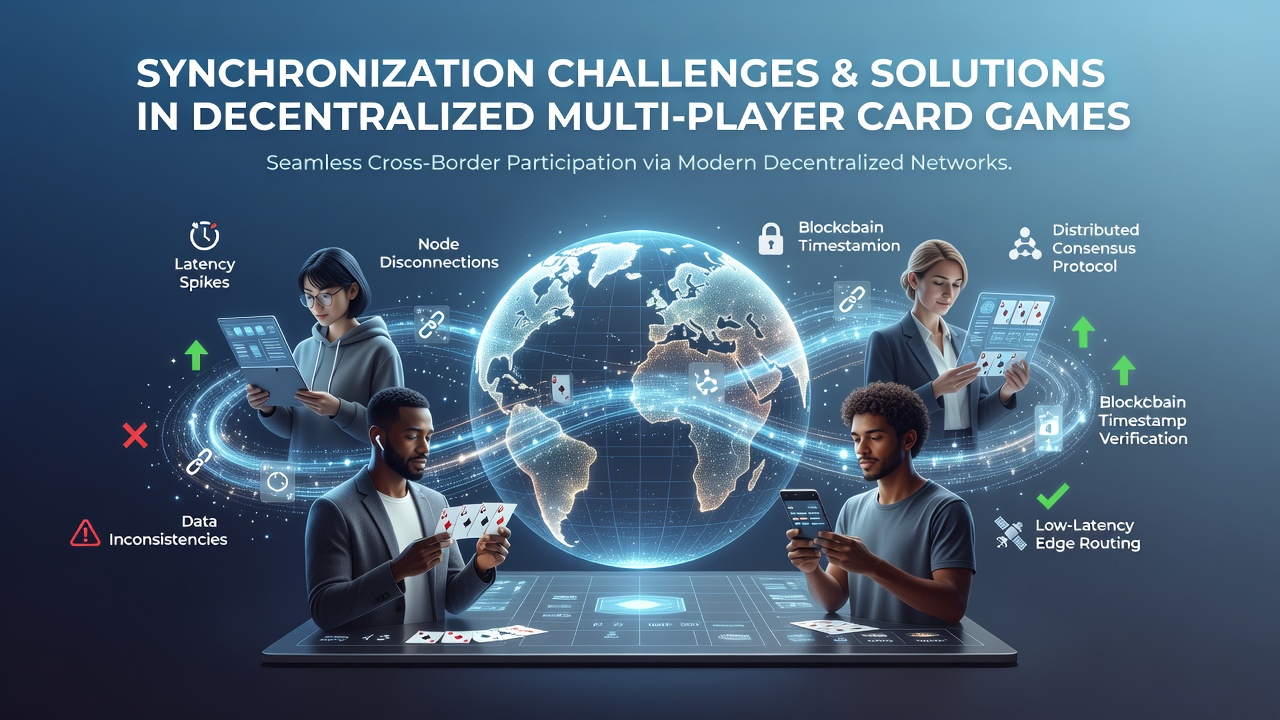
Network latency stands out as a primary obstacle because data packets carrying game moves travel through varied internet pathways, and observers note that delays exceeding 200 milliseconds frequently result in desynchronized views where one player sees a card revealed while another still awaits confirmation. Consensus mechanisms like proof-of-stake add another layer of complexity since they require multiple nodes to validate each transaction before updating the shared game state, which can stall real-time interactions during peak hours when global participation spikes. Data from industry reports shows that packet loss rates climb in cross-border scenarios due to routing inefficiencies, leading to situations where game sessions fragment and require rollback procedures to maintain fairness.
Security concerns compound these technical difficulties because decentralized setups must prevent cheating through node manipulation while preserving the integrity of shuffled decks and betting actions. Those who've examined blockchain-based card platforms report that fork events in the underlying ledger occasionally split player experiences, forcing reconciliation protocols that pause gameplay until all nodes align on the correct sequence of events. Regulatory differences across jurisdictions further complicate matters, as data localization rules in certain countries restrict how game information flows between servers located in separate territories.
Impact on cross-border player participation
Players joining from locations with limited broadband infrastructure encounter amplified problems since slower connections struggle to keep pace with the rapid state updates needed for games like poker or bridge variants hosted on distributed ledgers. Evidence suggests that time zone differences also play a role because peak activity periods overlap unevenly, causing node overload in one region while others remain underutilized. This imbalance affects reward distribution timing and session continuity for international users who expect uninterrupted play regardless of their geographic position.
Technical solutions addressing latency and consensus delays
Developers have implemented layer-2 scaling solutions that process transactions off the main chain before settling final states, which reduces confirmation times and allows smoother synchronization across distant nodes. Sharding techniques divide the game network into smaller segments that handle localized player groups, minimizing the distance data must travel while maintaining overall ledger consistency. Predictive algorithms anticipate player moves based on historical patterns and pre-validate potential actions, cutting down on real-time validation waits according to findings in distributed systems research.

Hybrid models combine on-chain security with off-chain computation for non-critical elements like visual card animations, ensuring core mechanics remain tamper-proof while user interfaces respond instantly. Studies from research institutions highlight that these approaches have lowered average synchronization errors in tested environments by significant margins during 2025 trials. As of July 2026, several platforms report ongoing refinements to these methods as node participation continues to expand globally.
Regulatory and infrastructure considerations for international play
Government agencies in multiple regions have begun examining how decentralized gaming networks comply with cross-border data transfer standards, prompting developers to adopt region-specific node configurations that respect local laws without sacrificing overall network performance. Industry organizations such as those focused on digital gaming standards emphasize the need for standardized APIs that facilitate seamless handoffs between different regulatory zones. Academic papers from European universities detail experiments where adaptive routing protocols reroute traffic around congested pathways, maintaining consistent game state updates for participants spread across continents.
Case examples show platforms experimenting with edge computing nodes placed closer to high-density player areas, which cuts transmission times and supports more reliable participation from emerging markets. These implementations rely on continuous monitoring systems that detect desynchronization early and trigger automatic corrections before players notice disruptions.
Conclusion
Decentralized networks continue to evolve solutions for synchronization challenges in multiplayer card games, with ongoing advancements in scaling techniques and node management enabling broader cross-border engagement. Research indicates that combining multiple approaches yields the most reliable outcomes for maintaining fair and continuous play across varied international infrastructures.